Resolution of the Assembly of the Serbian Orthodox Diocese of Canada
RESOLUTION
of the Annual Assembly of the Canadian Diocese
of the Serbian Orthodox Church in the Year of Our Lord 2026
We, the clergy, monastics, and representatives of the faithful people of God,
the duly appointed and elected members of the Annual Assembly
of the God-protected Canadian Diocese of the Serbian Orthodox Church,
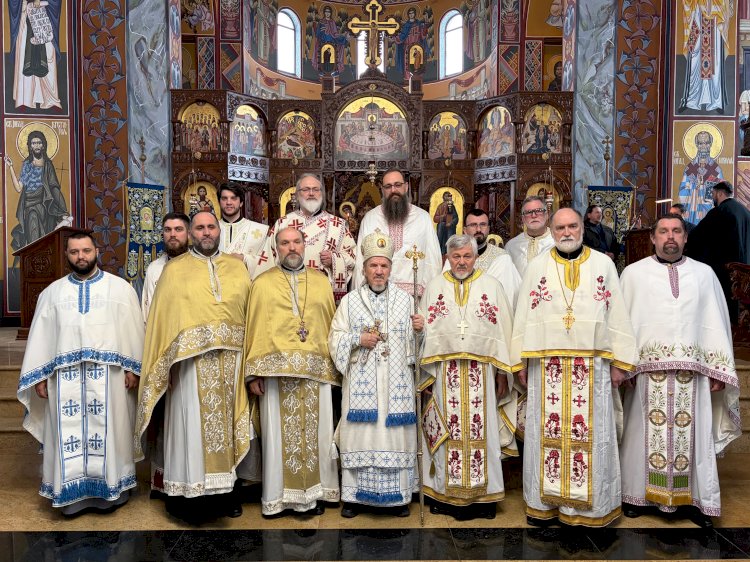
gathered in the Church of the Assembly of Serbian Saints
in Mississauga, Province of Ontario,
on Friday, the 20th day
of the Year of Our Lord 2026, on the Feast of Saint Parthenius of Lampsacus,
called together by the grace of the Holy Spirit,
paternally led by our Hierarch,
His Eminence Archbishop of Toronto
and Metropolitan of Canada, Dr. Mitrophan,
conscious of the sacred responsibility we bear before God, the Church, and our people, unanimously proclaim the following:
- Filial Loyalty and Prayerful Greetings
First and foremost, we offer prayerful greetings and express our filial devotion to His Holiness, Archbishop of Peć, Metropolitan of Belgrade-Karlovci, and Serbian Patriarch Porfirije, as well as to the Holy Assembly of Bishops and the Holy Synod of the Serbian Orthodox Church.
With the same sense of spiritual closeness, we greet the faithful people in all Serbian lands and throughout the diaspora, bearing witness that liturgical unity in Christ transcends all geographical and temporal distances.
- Unity as a Spiritual Covenant
The Diocesan Assembly issues a strong call for the unity of the Serbian people, reminding us that unity is not external uniformity, but the fruit of spiritual harmony in truth and love. Unity is not built by force, nor maintained by interests, but by humility, patience, and the awareness that differences are natural, yet divisions can never be blessed. We recall the apostolic words to be “one body and one Spirit” (Eph. 4:4), for every division inevitably wounds the community.
The unity of the Church is not an administrative formula nor an institutional framework, but above all a Eucharistic mystery. In the Divine Liturgy we do not gather as individuals, but become one Body of Christ.
The Eucharist is not an assembly of like-minded people, but a gathering of those who are different, whose foundation is Christ. For this very reason, every discord within the Church is not merely an organizational or human problem, but a deep spiritual wound upon the Body of Christ.
We remind all that the Church is not a space for affirming personal ambitions, nor a place where human weaknesses are concealed by spiritual language. Canonical order is not a legal formality, but the expression of the Church’s centuries-long experience. Obedience is not humiliation of the person, but the path of healing from egocentrism; and freedom in the Church is not self-will, but the capacity to live in truth and love.
True freedom is always inseparable from responsibility; where freedom is separated from love — division is born. Where truth is separated from humility — condemnation arises. Therefore, the Church continually reminds us that the path to God is not realized in isolation within one’s own “self,” but in a relationship of love toward the other. The other person is not an obstacle to our freedom, but the space of its fulfillment. As the Gospel and the Tradition of the Holy Fathers teach us, man is saved in communion, not in isolation. In encountering our neighbor, we discover the measure of our humility, the authenticity of our faith, and the depth of our love.
We recall that love for God cannot exist without love for man, for “he who does not love his brother whom he has seen, how can he love God whom he has not seen?” (1 John 4:20). Therefore, we are called to recognize in every person the image of God, to build peace, forgiveness, and understanding in our relationships, knowing that through this communion of love man grows toward the fullness of communion with God.
- Unity within the Diocese
Our Diocese, as a living and complex ecclesial community within multicultural Canadian society, is called to bear witness to conciliarity as a way of being — an inner spirit and measure of Church life — not merely as a form of governance or organizational activity.
Conciliarity is not an administrative principle, but a spiritual reality of the Church founded upon mutuality, responsibility, and the awareness that each member lives and acts within the one Body of Christ. It is manifested through mutual respect, cooperation, and the proper understanding of the various gifts and ministries entrusted by the Lord to His Church.
We call the clergy to brotherly harmony and spiritual responsibility, the faithful to liturgical awareness and ecclesial maturity, and the Church-School Congregational Boards to carry out their service in a spirit of conciliarity, responsibility, and sincere dedication to the unity of the community.
In this spirit, the Diocesan Assembly particularly emphasizes that the priest occupies a central place in parish life — not by human measure, but by the very nature of the priestly ministry. He is the one who liturgically gathers the people of God, spiritually guides the entrusted community, and bears pastoral responsibility before God and the Church.
Therefore, the healthy and fruitful life of every parish necessarily and unconditionally presupposes a harmonious relationship of cooperation, trust, and mutual respect between the priest and the Church-School Boards, as well as all other ministries within the community. By safeguarding order, the dignity of ministries, and the spirit of unity, the community builds a stable foundation for its spiritual growth.
For precisely in such conciliar balance and mutual respect, the Church most fully manifests her nature as a community of love, order, and spiritual maturity.
We recall the teaching of Saint Bishop Nikolaj Velimirović: “The Church is not an institution, but an organism; not a building, but a living body.”
For this reason, there are no “owners” in the Church — we are all servants of one Body and one Truth.
Church property is not merely material possession, but the fruit of the sacrifice, labor, and great faith of our forebears, a sacred inheritance that obliges all generations. It is a covenantal responsibility toward future generations. Therefore, it is not an object of material competition, but a holy trust which we are bound to preserve with spiritual responsibility. We call upon all Church-School Congregations, communities, and clergy to administer church assets conscientiously, responsibly, and transparently, mindful that what was created by sacrifice may be lost through negligence or passion.
- Care for the Suffering People
With a deep sense of spiritual solidarity, we offer prayers for our people, especially in Kosovo and Metohija, as well as in all regions where our people live in difficult circumstances. The Church knows neither forgetfulness nor indifference, for the suffering of some becomes a spiritual call to all.
The Assembly of the Canadian Diocese, at its regular session, expresses unwavering support for Republika Srpska. Our faith and responsibility toward the fraternal Serbian people in Republika Srpska encourage us to continue praying for peace, stability, and progress, as well as for the preservation of its institutions. In these difficult times, as we face challenges at every step, we as the Canadian Diocese express solidarity with the people of Republika Srpska and our conviction that God’s mercy will continue to guide their path of peace and prosperity. Our prayers are with them, and our support remains firm and unwavering.
We are reminded that prayer is the deepest and most exalted form of care, for in prayer a person stands not only before God, but brings the entire world into his heart. Through prayer we show that the suffering of our neighbors is not distant from us, but becomes part of our personal spiritual life and responsibility.
- A Call to Return to the Foundations of Spiritual Life
The Diocesan Assembly, with pastoral responsibility, points to the profound spiritual challenges of contemporary society.
We live in a time when truth is relativized, values become fluid, and man — despite technological progress — often remains spiritually disoriented and inwardly lonely. Contemporary culture increasingly offers comfort without meaning, freedom without responsibility, and individualism without community, creating an illusion of fulfillment while leaving man in deep inner emptiness.
The consequence of such a way of life is not true freedom, but spiritual instability and the loss of inner peace. Precisely in such circumstances, the Church continually calls for a return to the foundations of spiritual life, reminding us that prayer, fasting, repentance, and liturgical life are not external religious forms, but the path of transformation of the human heart.
A person who loses a living connection with prayer gradually loses inner balance, and without inner peace also loses the capacity for true understanding, communion, and love. Prayer thus becomes the space in which man rediscovers meaning, measure, and spiritual equilibrium in his life.
- Family and Identity in the Diaspora
In the conditions of the diaspora, where processes of assimilation are strong and often imperceptible, the Orthodox Christian family remains the key and irreplaceable place for preserving spiritual, cultural, and national identity. The family is not merely a natural community of life, but — according to the Church’s profound theological understanding — a domestic church, a space where faith is lived, transmitted, and witnessed.
Faith cannot be reduced to custom, nor identity to an external marker. What is not lived is gradually lost. Therefore, we call upon parents to make their homes places of prayer, love, forgiveness, and spiritual upbringing, knowing that it is precisely in family life that children first encounter the Church, faith, and the meaning of community.
We especially emphasize the importance of preserving the Serbian language within the family, for it is in the home that children first learn who they are, to whom they belong, and what they carry from their heritage. The language spoken in the home becomes the language of the heart and memory. By preserving language in the home, we preserve a living connection with our origin and faith.
At the same time, the authenticity of our faith is measured not only by words, but by deeds of love. Therefore, we call upon all parishes and church communities to cultivate a spirit of pastoral care, mutual support, and mercy, for the Church is not a community of the perfect, but of those who are healed, renewed, and saved in Christ. In this work of mercy, the youth and the Circle of Serbian Sisters play a significant role, being called to support their priest and to be active participants in the life and witness of faith and community.
- Gratitude
Finally, the Diocesan Assembly extends sincere greetings and expresses respect to the Mayor of the City of Mississauga, Ms. Carolyn Parrish, as well as to representatives of the civil authorities.
Likewise, it expresses gratitude to the Lord, to our Hierarch, the clergy, monastics, and faithful people, as well as to the hosts of this year’s gathering — Very Reverend Fathers Dejan Obradović, Milojko Dimitrić, and Zlatibor Đurašević — and to all members of the Church-School Congregation and volunteers who contributed to the organization of this Assembly.
We bear witness that every assembly of the Church is above all a gift of God’s grace and a manifestation of unity in Christ. Praying that the Lord strengthen us in these blessed days of the forthcoming Great Lent, we remain called to carry the spirit of this Assembly into the daily life of our parishes and communities.
Given in Mississauga,
in the Year of Our Lord 2026
AMEN.